How to take payments at a farmers market: cash, cards, and tap-to-pay
Never lose a sale over how someone wants to pay
The worst moment at a market booth is watching a ready buyer set your product down and walk because you couldn't take their money. Someone only has a card and you're cash only. Someone hands you a large bill and you can't break it. Every one of those is a sale you already earned and then gave away.
The fix is simple: take more than one kind of payment. Cash plus a card option is the baseline now. Add a peer-to-peer app as a backup and you've closed almost every gap. The rest of this guide is how to do each part fast and clean so the line keeps moving.
How much cash to bring, and a fast way to make change
Bring a starter float, the cash you begin the day with so you can make change before you've sold anything. A common starting range lands somewhere around a hundred to a hundred and fifty in small bills, but treat that as a rule of thumb, not a rule. Your real number depends on your price points and how busy your market is.
Weight the float toward what you'll actually hand back. Lots of ones and fives, a stack of tens, and a roll of quarters if any of your prices aren't round. If most of your prices are whole dollars, you'll need fewer coins and more singles. After a few markets you'll know your own mix.
To make change fast, keep your bills sorted by denomination, not jumbled together. Count the change back out loud as you hand it over. And keep the customer's bill visible on the lip of your apron or drawer until the change is in their hand, so nobody can honestly claim they gave you a twenty when it was a ten.
Keep your cash on your body, not on the table
Wear a cash apron. It keeps your money on you, frees up the table for product, and lets you serve the next person without turning around. An open cash box sitting on the table is an invitation, easy to grab when you're distracted by a rush.
Keep your large bills separated and out of sight, and do quiet drops through the day, moving big bills to a zipped pouch or your vehicle so you're never carrying the whole day's take in your apron.
Taking cards: a small reader or your phone
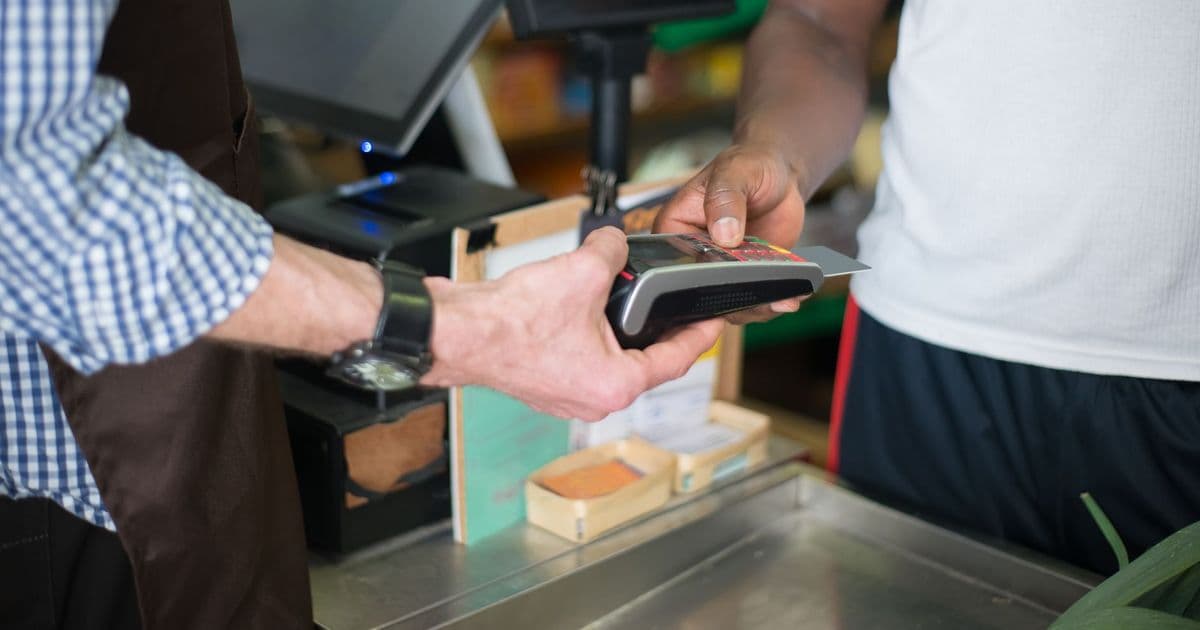
You have two easy paths. The first is a mobile card reader, a small device that pairs with your phone or tablet over Bluetooth and runs through a free app. These readers generally accept chip, swipe, and contactless taps, which covers the wallet apps people pay with from their phones. Several well-known processors offer these readers (you will see names like Square, PayPal, SumUp, and Stripe come up). Products, names, and supported features change over time, so compare current options and fees on each provider's own site before you choose.
The second path skips the separate device. Many newer phones can take a contactless tap directly through a payment app, turning the phone itself into the terminal. Whether your specific phone qualifies changes over time and by region, so check the current requirements for your device and processor before you count on it.
Either way, set it up and run a test charge at home, not in front of your first customer.
How card fees actually work
Here's the part the ad-style articles get wrong. Card processors generally charge two things on each sale: a percentage of the amount, plus a small flat fee per transaction. That flat piece is why tiny sales sting most. On a small sale the fixed fee is a bigger slice of the total than it is on a large one, so card costs feel heavier when your average ticket is low.
I'm deliberately not quoting a percentage here, because published rates change and vary by provider and plan. Look up the current rate on the processor's own page before you choose. Understand the structure, percentage plus a flat fee, and you can read any provider's pricing honestly.
Minimums, surcharges, and cash discounts
You may have heard you can set a card minimum or pass the fee to the customer. Sometimes you can, but the rules are a patchwork of state law and card-network policy, and surcharging is restricted in some states. A cash discount, advertising a lower price for cash rather than adding a fee for cards, is generally treated more permissively than a surcharge. Keep it general and confirm both your state's rules and your processor's terms before you post any sign.
Peer-to-peer apps: a good backup, not your main lane
Venmo, Cash App, and Zelle can make a solid fallback and often land fast, but business use can carry fees and the terms change, so check each app's current business terms. But they're slower at the counter, the customer has to find your handle and type the amount, and they're harder to reconcile at day's end. Think about a business profile versus your personal one, and remember that some peer-to-peer transfers are hard to reverse once sent, so treat them like cash. Use these as a second option, with a printed QR code at the booth, not as your primary register.
Tell people you take cards before they walk past
Plenty of shoppers assume every vendor is cash only and skip the booth rather than ask. A small, clear sign that says you take cards and tap to pay recovers those sales. Add your peer-to-peer QR code on the same sign, and mount the reader where the customer can reach it themselves.
When the signal drops
Cell signal at an outdoor market can vanish without warning, so build a layered backup. If your processor offers an offline mode, turn it on before you leave home. Carry a charged power bank and the right cable. A phone hotspot can rescue a tablet. And keep cash plus that peer-to-peer QR as the fallback that always works. Shade your device from direct sun and keep it dry when the weather turns.
SNAP, EBT, and your market's own rules
Many markets run a central SNAP and EBT program where the market swipes the card and gives the shopper tokens or scrip to spend at booths, and you redeem those tokens later. One firm rule across these programs: never give cash change on SNAP tokens. The exact mechanics, denominations, and redemption vary by market, and your vendor agreement may also dictate which payment types you're allowed to accept, so ask your market manager.
Close out: count, compare, and record
At the end of the day, count your cash drawer back down and subtract your starting float to see your cash sales. Pull the card total from your app and the peer-to-peer total from yours. Log the day's total, ideally broken out by product, with the date. Keep business and personal money separate, and save the records. A simple income-and-expense spreadsheet, or your reader app's own report, is plenty to start and doubles as tax prep later. Whether your products are taxable, and how, varies by state, so check with your state revenue department.
A simple market-day payment kit
- Cash float in sorted small bills, plus a roll of quarters
- Cash apron and a zipped pouch for drops
- Phone or tablet, card reader, and the app set up and tested
- Charged power bank and the right cable
- A sign saying you take cards and tap to pay, with your peer-to-peer QR
- A notebook or spreadsheet for the end-of-day count
Take cash, take cards, keep a backup, and price in round numbers so the line never stalls. Do that and the only reason a customer leaves empty-handed is that they decided not to buy, not that you couldn't take their money.
This is educational information, not legal or financial advice. Card-fee rules, surcharge laws, and benefit-program details vary by state and change over time, so always confirm the current terms with your processor, your state, and your market before relying on them.
Keep reading
How to accept SNAP/EBT and WIC at a Texas farmers market
Accept SNAP and WIC benefits at your market stand to reach more customers and boost sales. Authorization, equipment, and setup are free; here's how the process works.
7 min readHow to accept SNAP/EBT and WIC at a Florida farmers market
Accepting nutrition benefits widens your customer base. A Florida-specific guide to SNAP/EBT vendor authorization, how markets run a central EBT terminal, Fresh Access Bucks, and the electronic WIC and senior Farmers' Market Nutrition Program, with who to sign up with for each.
7 min readGet the next guide in your inbox
Practical market-business tips every couple of weeks. No spam, unsubscribe anytime.